OCPI 2.2.1 · CPO simulator
A CPO that isn't real.Sessions that are.
Register your eMSP backend against an OCPI 2.2.1 CPO. Connect an EV, start a session, watch the energy accrue, and pull the CDR — in development, in CI, and against production.
- No partner CPO required
- No car at a charger
- Deterministic in CI
$ curl -H "Authorization: Token $TOKEN" \
    https://acme.sandbox.plugbench.dev/ocpi/versions

{ "data": [ { "version": "2.2.1", "url": "…/ocpi/2.2.1" } ],
  "status_code": 1000,
  "timestamp": "2026-08-02T09:14:22Z" }
You cannot test what you cannot talk to.
- Your integration is blocked on a partner contract.
- Your test needs a car plugged into a real charger.
- Your callback bug only happens at 03:00, in production.
How it works
Three steps to a CDR.
- 01
Point at the versions URL
GET /ocpi/versions with your bootstrap token. Discovery returns absolute module URLs and interface roles, exactly as a real CPO would.
- 02
Complete the handshake
POST your credentials and get a generated token back. Rotate it with PUT. Deregister with DELETE. Then do it all again.
- 03
Drive it
Connect an EV, swipe an RFID token or send START_SESSION. Power tapers as the battery fills. One immutable CDR falls out the other end.
What it does
A backend that argues back.
Callbacks arrive out of order. On purpose.
Request order never implies callback order. So you find out today whether you really correlate on response_url — instead of at 03:00 next February.
Nine modules, not a stub
Versions, Credentials, Locations, Tariffs, Sessions, CDRs, Tokens, Commands and Charging Profiles. Real envelopes, real X-Total-Count and Link headers, real four-digit status codes.
Break it deliberately
Force any remote command to be rejected, to stall for up to 60 seconds, to fail — or to never call back at all.
Deterministic by design
Scenarios are JSON. A reset restores byte-equivalent state and the same identifiers. Same test, same result, every run.
Charging that behaves
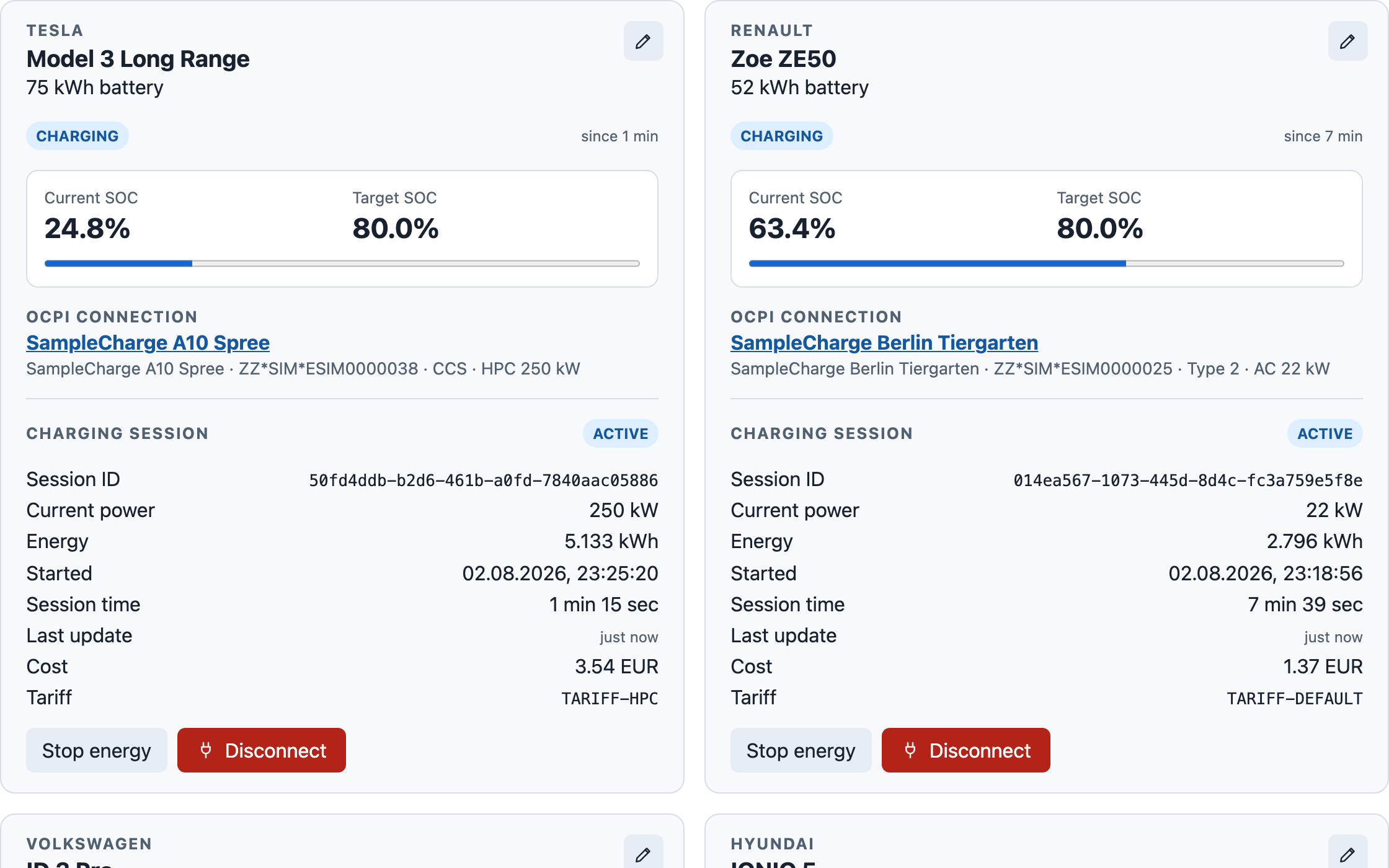
EV profiles with real battery sizes, AC and DC limits and connector compatibility. Set a starting and a target SOC; power tapers as the battery fills; reaching the target stops delivery.
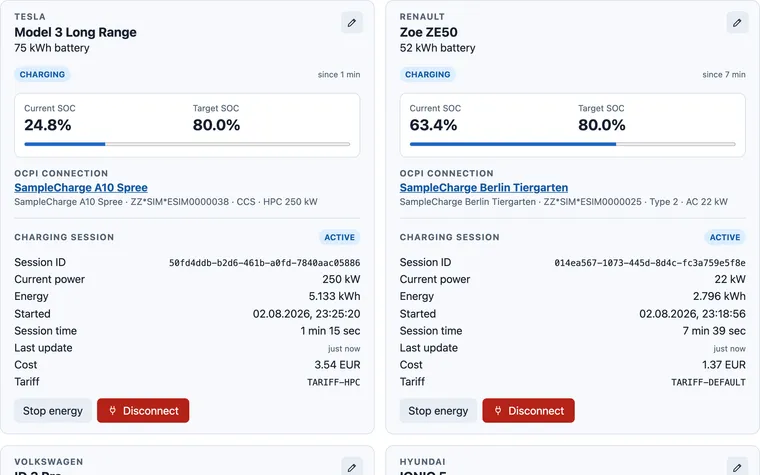 Open full size
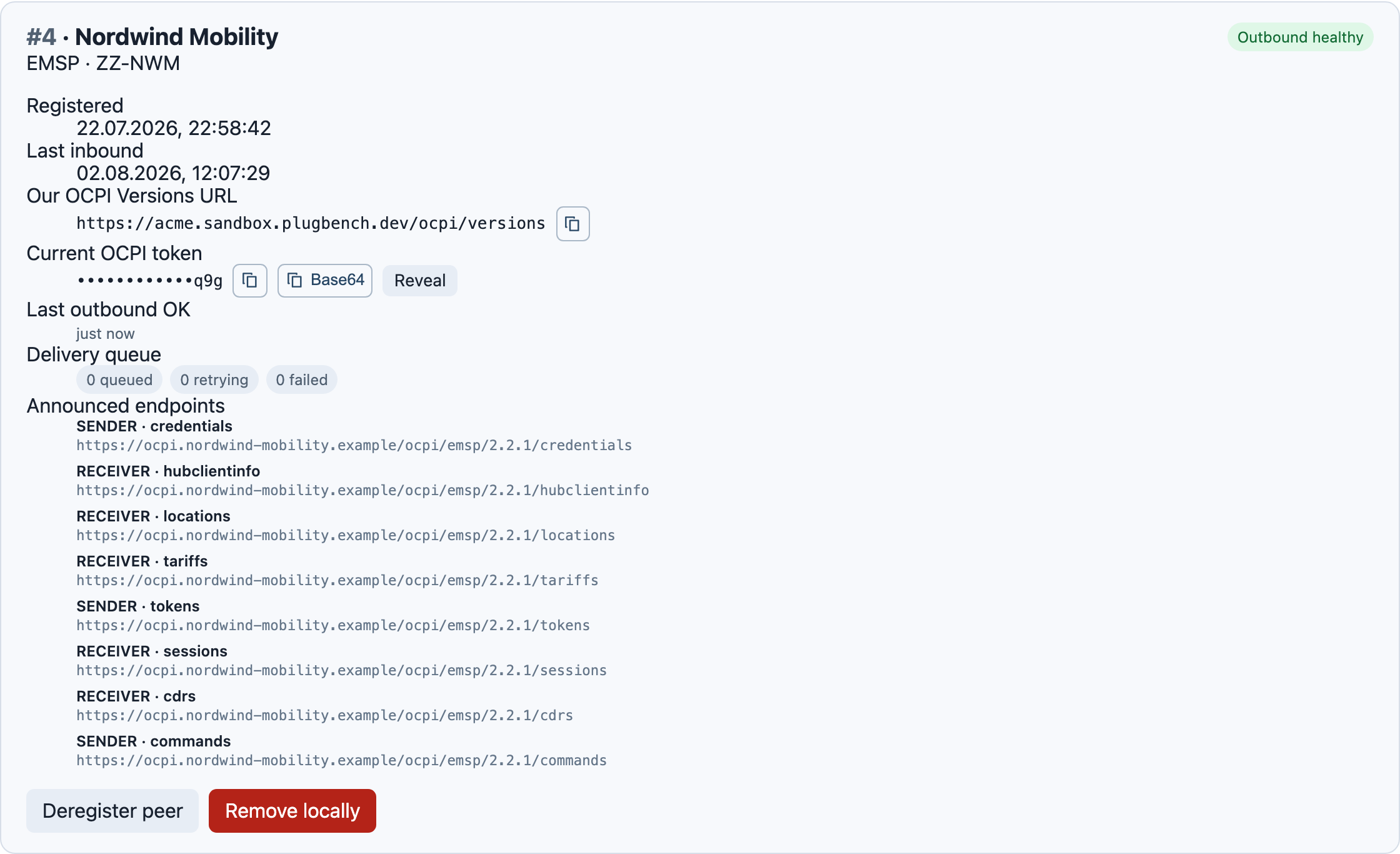
The handshake, end to end
Register, rotate, deregister — the part that breaks first, and the part no hand-written mock ever covers.
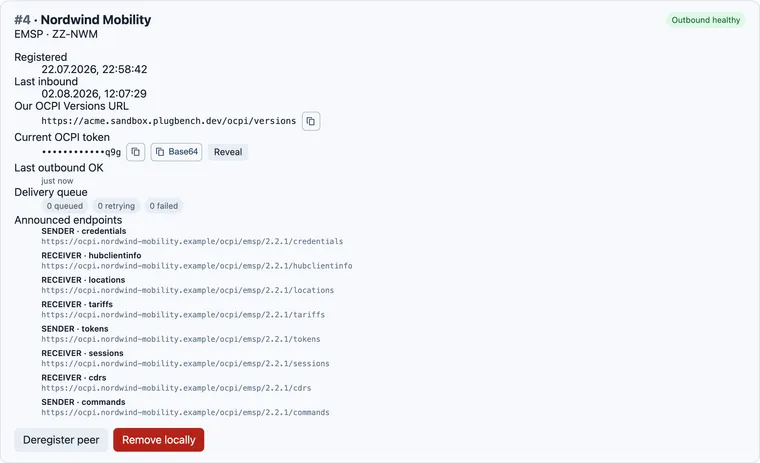 Open full size
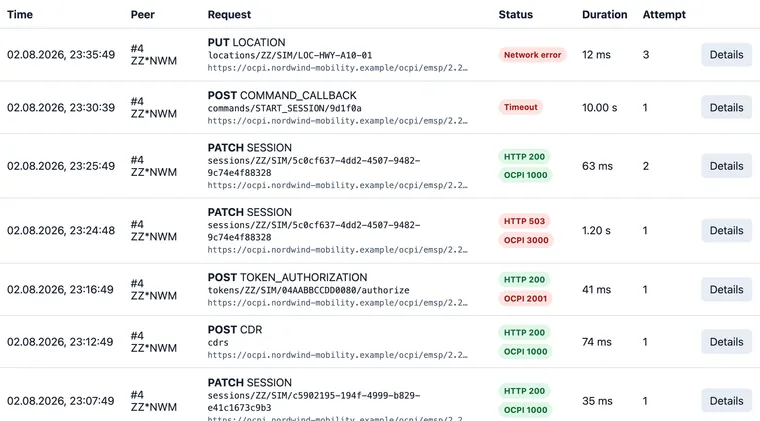
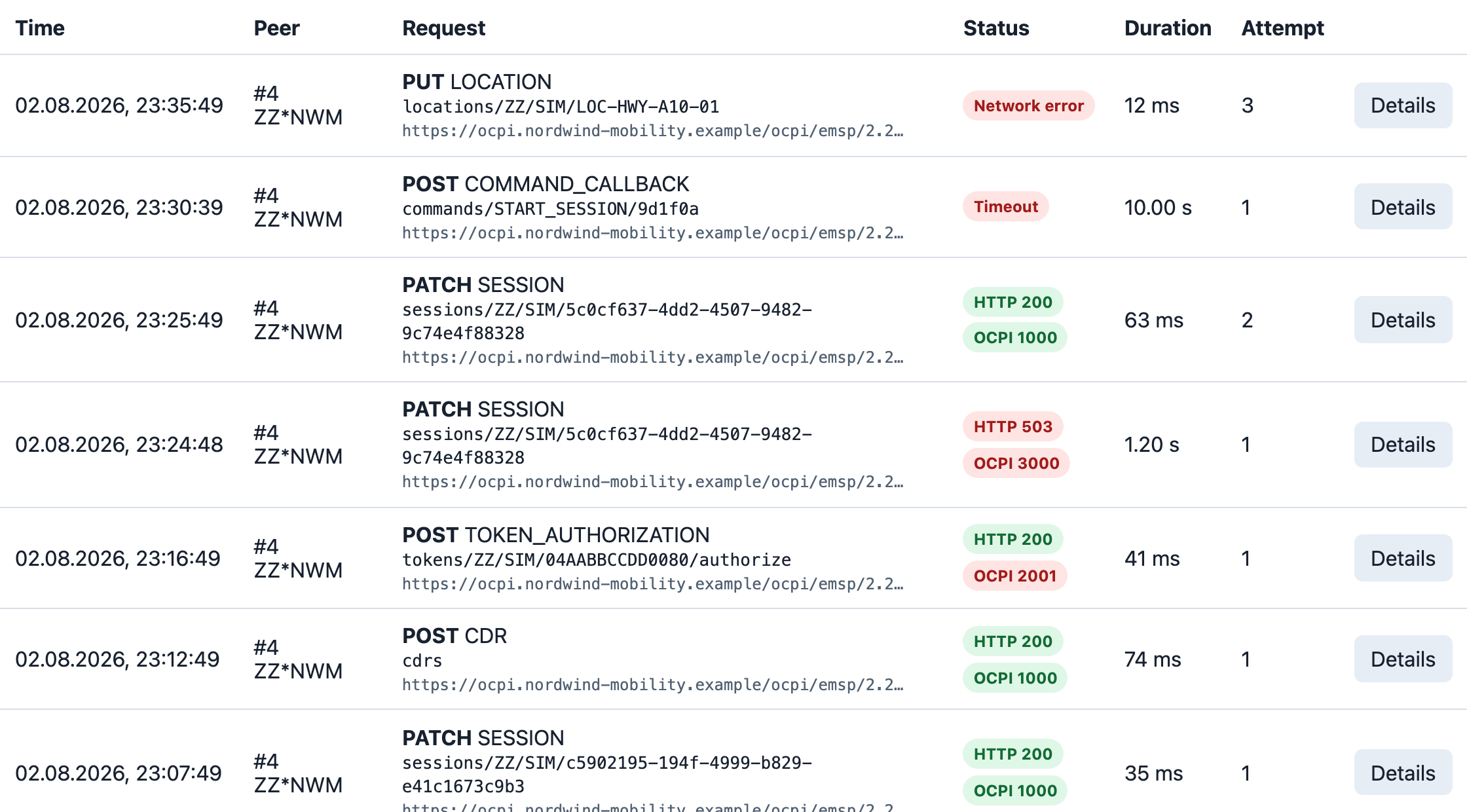
Every request, both directions
Inbound and outbound attempts with exponential-backoff retries, durations and OCPI status codes. Credentials redacted, always.
 Open full size
Where it runs
Development, CI, and production.
In development
A sandbox endpoint your local stack registers against. No infrastructure to run, no database to babysit.
In your pipeline
Deterministic fixtures behind a reset, so a red build means your code changed — not the world.
Against production
A permanent peer your live stack registers with, for end-to-end synthetic checks on the real path.
Who builds it
Built by an EMP that runs it in production.
EV-Freaks builds ChargEV FleX, a live E-Mobility Provider. plugbench is what we test it with, every day. No customer logos and no testimonials — the protocol either works or it doesn't.
Ready to break something?
Tell us what you're integrating. You get a sandbox endpoint and a bootstrap token.